
Most offsites go wrong before anyone books a resort. Someone in leadership says the team needs to “get away and reconnect”, HR is handed a budget and a date, and the search begins for a nice property within driving distance of Bangalore. Three weeks later there is a signed contract, a WhatsApp group full of logistics questions, and a nagging feeling that nobody actually agreed on what the offsite was meant to achieve.
The location, the format and the budget are not three separate decisions. They depend on each other, and getting the sequence wrong is why so many offsites end up as a nice two days away that people forget by the following Monday. This guide sets out how to think through all three properly, in the order that actually works, for teams planning corporate offsites near Bangalore.
Start with the objective, not the resort
Before anyone looks at a map, someone has to answer a blunt question: what is this offsite for? A leadership team working through a strategy reset needs long, uninterrupted stretches of facilitated discussion and almost no distraction. A sales team celebrating a strong quarter needs energy, recognition and a bit of spectacle. A department that has been through a reorg needs structured time to rebuild working relationships, which is a very different agenda from either of the above.
Each of these needs a different kind of property, a different agenda structure and a different budget. Skipping this step and going straight to venue shortlists is the single biggest reason offsites feel generic. If you are still working out what good would look like, it is worth reading through our corporate events page for a sense of how different formats map to different business objectives before you go further.
Why proximity to Bangalore actually matters
There is a genuine trade-off between distance and depth. Properties within 60 to 90 minutes of the city, around Nandi Hills, Devanahalli, Bannerghatta Road or the Mysore highway stretch, let you run a one-day or one-and-a-half-day offsite without eating into a weekend or requiring flights. Teams arrive by 10am, get a full working day, stay overnight if needed, and are back at their desks or homes by early evening the next day.
Push further out, to Coorg, Chikmagalur or the Nilgiris, and you gain scenery and a genuine sense of disconnection, but you lose a full day to travel each way. That only makes sense if the offsite itself justifies three or four days. A one-day strategy session does not need a six-hour drive on either end. Matching travel time to session length sounds obvious written down, but it is the detail most commonly overlooked when someone falls in love with a property photo.
Choosing the actual location
Once the format is roughly settled, location choice comes down to a short, practical list:
- Drive time from where most of the team actually lives, not from the office address on paper
- Whether the property has one dedicated conference space that seats your group without pillars or a bad projector angle, not just a banquet hall repurposed for the day
- Backup indoor space in case of rain, particularly between June and September
- Network and power reliability if any part of the agenda needs a video call, a livestream to remote employees, or laptop-heavy breakout work
- Whether the property can house the whole group under one roof, since splitting a team across two hotels quietly kills the point of an offsite
A detailed shortlist of venues, with capacity and format notes, is covered in our separate guide to the best venues for corporate events in Bangalore, which is worth reading alongside this one if you are at the shortlisting stage.
Formats that hold up beyond the first afternoon
The format question is really about pacing. A common mistake is packing a two-day offsite with back-to-back sessions from 9am to 9pm, which leaves people exhausted and disengaged by the second morning. A structure that tends to work better looks like this: a focused morning block for the hardest strategic conversation, when energy is highest, a lighter afternoon mixing smaller breakout groups with an outdoor or team activity, and evenings kept deliberately unstructured or lightly social rather than programmed.
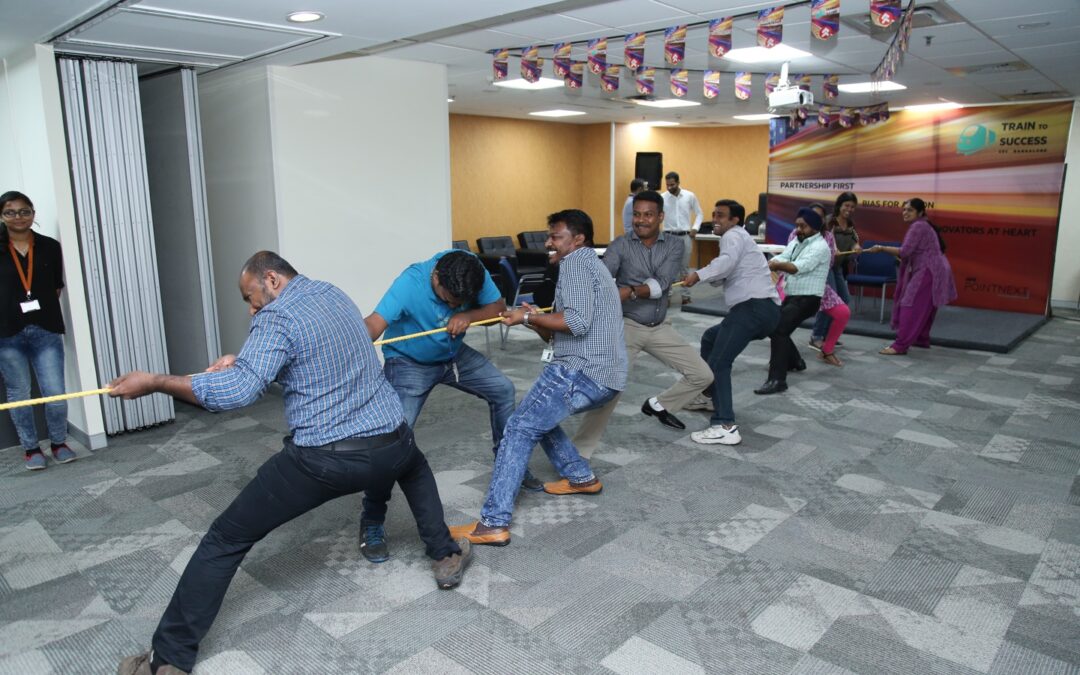
Three activity formats in particular tend to earn their place. A half-day challenge followed by a half-day unwind puts the structured problem solving in the morning, when energy is high, and lets the conversations continue naturally over a relaxed afternoon. Skill and craft sessions, cooking, pottery, drumming or an outdoor skill, put everyone on the same level regardless of seniority and mix people who never usually talk. Cause led outings, where a morning goes to a genuine community activity, give a team a shared sense of purpose that a treasure hunt cannot, and they travel well in your internal communications afterwards.
Two details decide more than the venue does. Keep travel under ninety minutes each way, because road time is the silent killer of a good offsite, and plan for the quiet people rather than only the loud ones. Always leave some unstructured time as well, since the best moments at an offsite are rarely the ones on the agenda.
For leadership offsites specifically, it helps to build in at least one session with no facilitator and no slide deck, just an open conversation with a clear question on the table. For larger team offsites, a mix of business updates in the morning and a structured team activity in the afternoon tends to land better than trying to cram both into every session. If you want a wider set of format ideas beyond offsites, we have covered twelve formats that work for Bangalore companies in a separate article, but for offsites specifically, keep the agenda simpler than you think you need to.
Budgeting an offsite realistically
Costs for a corporate offsite near Bangalore vary widely depending on group size, property category and how many days you run, but a few patterns hold. A one-day offsite for 30 to 40 people at a decent property within 90 minutes of the city, including venue hire, meals, a facilitator and basic AV, typically lands between 3 and 6 lakh rupees. Extend that to an overnight stay with rooms, and the number moves into the 6 to 12 lakh range for the same group size, depending on room category and whether you add a curated evening activity.
Larger offsites, 100 or more people over two nights at a resort property with dedicated activity zones, can run well into 25 to 40 lakh or beyond once you add transport, entertainment and a proper production setup for any town hall or awards element. None of these figures are fixed, and the honest answer to “what will this cost” is always “it depends on the four or five decisions you have not made yet”. We have broken this down in more detail, including what drives cost up or down, in our guide to what corporate event management costs in India.
Timing, logistics and the details nobody budgets for
Weekday offsites are usually easier to schedule and cheaper on venue rates than weekends, since resorts near Bangalore see heavy weekend leisure demand and price accordingly. Booking eight to ten weeks ahead gives you far better room inventory and rate flexibility than a four-week lead time, particularly for anything above 50 people.
Transport is the detail that quietly blows budgets. Chartering buses for 40 people from three different pickup points across Bangalore costs more, and takes longer to coordinate, than most planners expect, so build in a proper logistics plan rather than assuming everyone will “just drive up”. Similarly, if the offsite includes any formal segment, an address from leadership, an awards moment, a livestream to people who could not attend, treat that as a separate production requirement with its own AV brief, not an afterthought bolted onto a resort conference room.
Working with an agency versus running it in-house
Smaller, single-day offsites for one team are often manageable in-house, provided someone owns the agenda and the logistics fully rather than splitting the responsibility across three people. Anything larger, multi-day, cross-location, or involving senior leadership optics, usually benefits from an external partner who has actually run the venue negotiation and the format design before. If you are evaluating agencies for this, our piece on ten questions to ask before you sign with an event agency is a useful filter, and if you want to brief several agencies fairly so their quotes are actually comparable, our corporate event RFP template covers exactly that. The same discipline around structure and timelines applies whether you are planning an offsite or a larger set-piece like an annual day, which we cover separately in our annual day planning checklist.
Getting it right the first time
Zeroin has been running corporate events out of Bangalore since 1991, over 35 years now, and has delivered more than 5,000 events across formats including offsites, annual days and leadership retreats. We know which properties within driving distance actually work for which group size, and which ones look good in photos but fall apart with fifty people in the room. If you are planning an offsite and want a second opinion on location, format or budget before you commit, message us on WhatsApp at 9900998899 or get in touch through our contact page.