
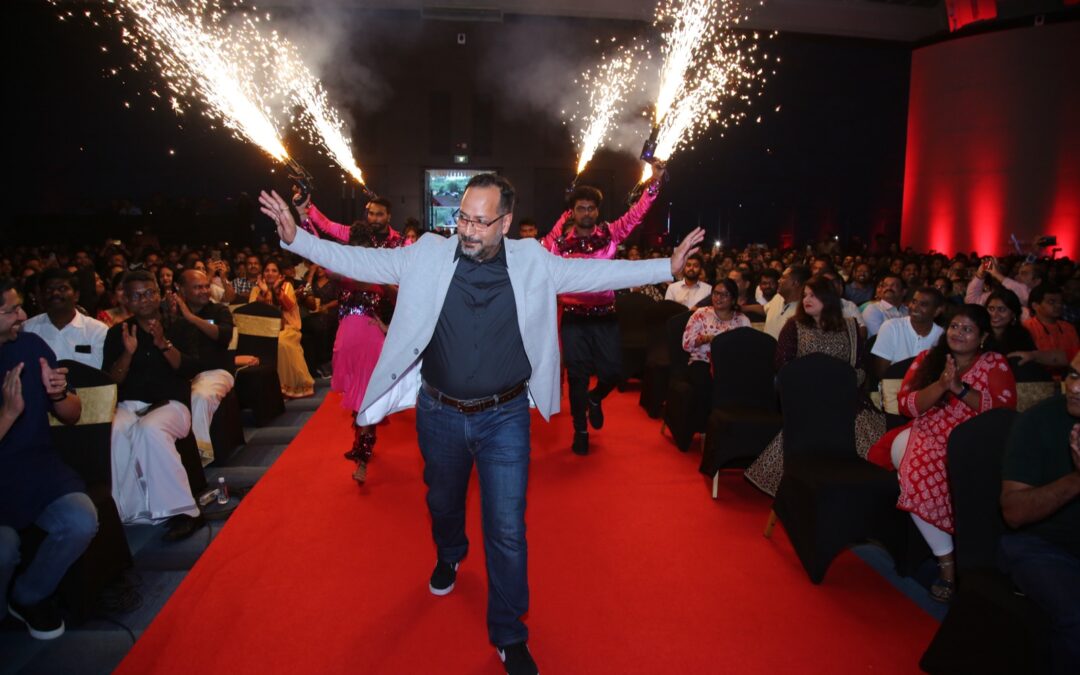
Most corporate teams choose an event management company on the strength of a good-looking deck and a competitive quote. Both are the wrong signals. A deck shows what an agency can imagine; a quote shows what it hopes to charge. Neither tells you what happens at 6.40pm on show day when the keynote speaker’s flight is delayed and 600 people are already seated.
That gap is where budgets get blown and reputations get dented. Below are the ten questions we would ask if we were sitting on your side of the table, along with what a good answer actually sounds like. We have run more than 5,000 events since 1991, and almost every problem we have seen traces back to one of these ten points going unasked.
1. Who will actually be on site on the day?
Agencies routinely pitch with their senior team and deliver with their junior one. Ask for the names and roles of the people who will be physically present on event day, and ask how many other events that same team is handling that week.
Good answer: a named project lead, a named production head, a stated crew count, and a commitment that the pitch team is the delivery team.
2. How many events like mine have you delivered in the last 24 months?
Not total events. Not the showreel from 2014. Events of your type, your scale, and your audience profile within the last two years. A team that runs 40 weddings a year is not automatically ready for a dealer meet or a shareholder AGM.
Ask for two references you can actually ring, ideally clients who are no longer working with the agency. Those calls are the most honest data you will get.
3. What is in the quote, and what is not?
The single biggest source of budget overrun in Indian corporate events is scope that was never priced. Get a line-item breakdown, then ask specifically about: venue and F&B taxes, generator backup, overtime for crew beyond a stated hour, artist travel and hospitality, statutory permissions, GST treatment, and last-minute headcount changes.
If a quote is materially cheaper than the others, it is usually not efficiency. It is scope that has been left out and will reappear as a variation later. For a fuller breakdown of what drives price, see our guide to corporate event management costs in India.
4. What is your escalation path when something breaks?
Every event has a failure. What separates agencies is the plan for it. Ask what happens if the venue’s power trips, the LED wall fails, the caterer under-delivers, or a speaker drops out with two hours’ notice.
Good answer: named backups, a redundancy plan for critical AV, an on-site decision-maker with the authority to spend, and a single point of contact for your team so you are not chasing three phone numbers.
5. Do you own production capability or subcontract everything?
There is nothing wrong with a specialist vendor network. There is a great deal wrong with an agency that is purely a middleman and cannot influence a vendor who is running late. Ask what they control directly, what they contract out, and how long they have worked with each subcontracted partner. Vendor relationships that go back years are worth more than the lowest bid.
6. What does your timeline look like, working backwards from show day?
A serious agency will hand you a reverse timeline within days: venue lock, creative sign-off, content freeze, rehearsal, load-in, show. If they cannot produce one, they are improvising. For most corporate events in Bangalore we recommend a minimum of six to eight weeks; large conferences and product launches need three to four months, particularly around peak season from October to February when the good venues are gone early.
7. How do you handle compliance and permissions?
Sound licences, fire and safety clearance, police permissions for public-facing events, liquor licences, copyright clearance for music, and insurance. In the government and public-sector space, add protocol, security coordination and empanelment requirements. Ask who carries the liability if a permission is missed. Get it in writing.
8. What happens if we need to change the date or cancel?
Ask for the cancellation and postponement terms before you are emotionally committed. What is refundable, what is transferable, and what is lost. Since 2020 every competent agency has a considered answer to this. An agency that waves the question away is one you will argue with later.
9. How will you measure whether the event worked?
An event is a business investment, not a party. Agree the measure upfront: attendance against invitation, session dwell time, engagement or NPS scores, leads captured, media coverage, or post-event survey results. Ask what reporting you will receive and when. If the only deliverable is photographs, you have bought decoration rather than an outcome.
10. Will it run on time?
It sounds trivial. It is not. Overruns cascade: the CEO’s slot gets cut, dinner service collapses, guests leave before the awards, and the client’s leadership remembers exactly one thing about the evening. Ask directly how the agency manages the run of show, who calls cues, and what their record is. Running on time is a discipline, not luck.
The shortcut: what a safe partner looks like
If you have limited time, weight three things above all others. Longevity, because an agency that has survived multiple downturns has systems rather than heroics. Relevant recent work, because capability decays fast. A named, accountable on-ground lead, because that is who saves you on the day.
Zeroin has been managing corporate events in Bangalore since 1991: over 5,000 events across conferences, product launches, annual days, award nights, dealer meets, team-building formats and government functions, with in-house production and a record of running on time.
Frequently asked questions
How much notice does an event management company need?
Six to eight weeks for a straightforward corporate event; three to four months for large conferences, product launches or anything requiring premium venues in peak season. Shorter timelines are possible but reduce your venue and talent options and usually cost more.
Should I run a formal RFP or approach agencies directly?
For events above roughly ₹25 lakh, a short structured brief sent to three or four agencies gives you comparable quotes and better negotiating position. Below that, a direct conversation with a shortlist of two is usually faster and just as effective.
Is the cheapest quote ever the right one?
Rarely, and almost never when the gap is large. Compare like for like on scope first. A quote that is 30% lower is usually 30% less event.
Can one agency handle multiple cities?
Some can, through owned teams or long-standing partner networks. Ask specifically which cities they have delivered in during the last two years rather than which cities they claim to cover.
Ready to compare us against that list?
Put these ten questions to us and see how the answers land. Learn more about what we manage on our corporate events page, or get in touch for a free, itemised proposal with a reverse timeline attached.